The Science of Colour Matching: How Pinelaki Achieves an Invisible Repair
April 13, 2026
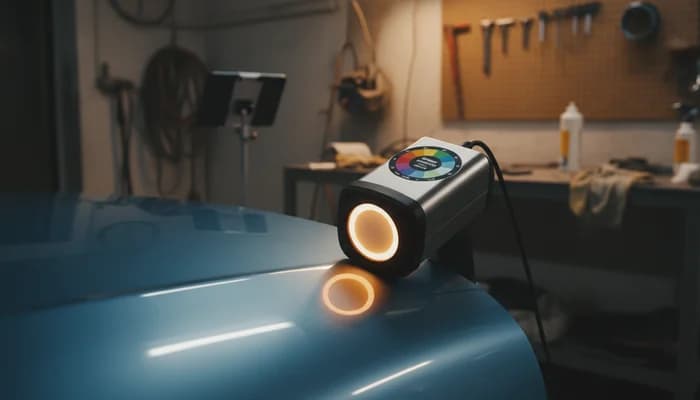
Computerised colour matching uses a spectrophotometer to read your car's exact paint formula, accounting for UV fading, metallic flake orientation, and pearl-coat depth so the new panel blends invisibly with the rest of the vehicle. Here is how the technology works and why 35 years of Cyprus experience makes the difference.
How Does a Spectrophotometer Read Your Car's Colour?
A spectrophotometer is essentially a precision camera that sees beyond the visible spectrum. When our technician presses the device against your panel, it fires a controlled burst of light and measures the wavelengths that bounce back. The result is a digital fingerprint containing three critical values: hue (the colour family), chroma (saturation), and lightness (how bright or dark the shade appears).
This data feeds into a mixing computer connected to the paint manufacturer's formula database. Rather than relying on a colour code alone, which describes the paint as it left the factory, the spectrophotometer captures the paint as it exists today on your specific car.
At Pinelaki, we use this technology on every single repair. Our Nicosia facility processes hundreds of readings per month, and the formula database contains over 150,000 automotive colour variants from manufacturers worldwide.
Why Does Cyprus Sun Make Colour Matching Harder?
Cyprus receives over 3,400 hours of sunshine per year, one of the highest levels in Europe. Ultraviolet radiation breaks down pigment molecules in your clear coat and base coat over time. A three-year-old white Toyota in Nicosia will not be the same white as the day it was sold.
This is why factory codes are only a starting point. If a body shop simply orders paint by the manufacturer code, the repaired panel may look noticeably darker or more saturated than the surrounding panels that have been sun-aged.
Our team compensates for this ageing effect. After the spectrophotometer scan, our colour specialist adjusts the formula using micro-tints, shifting the mixture to account for the years of UV exposure your car has endured. This adjustment process is where decades of local experience become irreplaceable. A technician who has matched colours under the Cyprus sun for 35 years can read subtle warm shifts that a technician from a northern European climate might miss entirely.
What Makes Metallic and Pearl Paints So Challenging?
Solid colours (plain white, red, black) reflect light uniformly. Metallic paints contain tiny aluminium flakes suspended in the base coat, and the size, shape, and orientation of those flakes change how the colour appears at different angles. Pearl paints add another layer of complexity with ceramic mica particles that refract light into multiple colours simultaneously.
A single metallic colour code can have five to ten factory variants depending on the production batch, the assembly plant, and even the season the car was manufactured. This is why two identical model cars parked side by side in a Nicosia lot can look slightly different under direct sunlight.
Our spectrophotometer captures data at multiple angles (15 degrees, 45 degrees, and 110 degrees from the light source), which allows us to map the flake behaviour. We then spray a test card, dry it, and compare it against the vehicle under both daylight and artificial light before committing paint to the panel.
How Does the Blending Technique Guarantee Invisibility?
Even a 99% colour match can be visible if there is a hard edge where new paint meets old. To eliminate this, we use a graduated blending technique. After painting the repaired area at full opacity, we extend the spray in a fading pattern into the adjacent panel. This gradient transition means there is no abrupt line for the eye to detect.
For metallic and pearl colours, we also apply a separate blending clear coat over the transition zone. This ensures the metallic flakes in the overlap area settle at the same angle as those in the original paint, preventing the "halo" effect that occurs when flakes are disturbed at an edge line.
What Quality Controls Does Pinelaki Use?
Every colour-matched repair at Pinelaki goes through a three-stage inspection. First, the colour specialist verifies the wet-spray test card against the vehicle. Second, after the repair is painted and cured, a senior technician inspects the panel under our daylight-simulation booth, which replicates the 6,500K colour temperature of midday Cyprus sun. Third, the finished car is taken outside and examined in natural light from multiple angles.
If any stage reveals a visible discrepancy, we recalibrate and respray. This three-check protocol is one reason our work carries a written warranty and why our customers return year after year.
Why Does Experience Matter as Much as Technology?
Technology provides data, but interpreting that data is a human skill. Our founder started Pinelaki in 1991, and our team includes technicians with over two decades of hands-on colour work. They know that a pearl white Toyota ages differently from a pearl white Hyundai because of different clear-coat formulations. They know that a car garaged in Limassol will fade differently from one parked outdoors in Larnaca.
This institutional knowledge cannot be downloaded from a software update. It is built one car at a time, over 35 years of work under the Cyprus sun.