Factory Finish Restoration vs Quick Detailing: Which Does Your Car Actually Need?
April 13, 2026
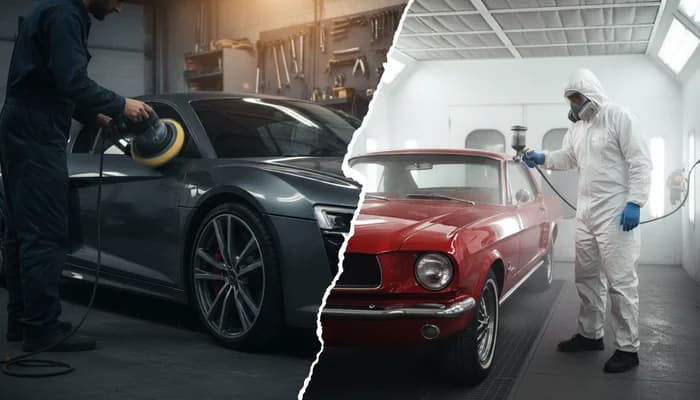
A professional respray restores your car's original layered protection (primer, base coat, and clear coat) and lasts 10 or more years, while detailing and polishing only address surface-level imperfections and typically last three to six months. Here is how to tell which service your vehicle actually needs and why the right choice saves money in the long run.
What Is the Difference Between a Respray and Detailing?
Detailing is a surface-level cosmetic treatment. A detailer uses compounds, polishes, and waxes to remove light oxidation, swirl marks, and minor scratches from the clear coat. The process does not add new paint. It simply refines the existing top layer to restore temporary gloss.
A factory finish restoration (respray) is a structural repair. The damaged area is stripped, primed, sprayed with colour-matched base coat, and sealed with a fresh clear coat. The result replicates the original factory paint system from the ground up.
The two services address fundamentally different problems. Detailing is maintenance. Respraying is restoration.
How Are Modern Car Paint Layers Structured?
Understanding paint layers helps clarify why some damage cannot be polished away.
E-Coat (electrocoat): The steel body is dipped in an electrically charged anti-corrosion bath. This is the foundation layer, typically 20 microns thick, and it prevents rust from forming.
Primer: A 30 to 40 micron layer sprayed over the e-coat. Primer provides adhesion for the colour coat and fills microscopic surface imperfections in the metal.
Base coat (colour): This is the actual colour you see. It is typically 15 to 25 microns thick and contains the pigments, metallic flakes, or pearl particles that define the shade.
Clear coat: A transparent protective layer, usually 40 to 50 microns, applied over the base coat. It provides UV resistance, chemical resistance, and the glossy finish you associate with a new car.
The total paint thickness on a modern car is roughly 100 to 150 microns, about the thickness of a sheet of paper. Each polishing session removes a few microns of clear coat. After two or three aggressive compounds, the clear coat becomes critically thin and can no longer protect the base coat beneath.
When Is Detailing Enough?
Detailing is the right choice when damage is confined to the very top of the clear coat. This includes light swirl marks from poor washing technique, minor water spots or bird-dropping etching, light oxidation or dullness on a car that has been parked outdoors, and minor surface contamination like tree sap or tar residue.
If you run your fingernail across the scratch and it does not catch, the damage is likely shallow enough for a polishing compound to address.
When Does Your Car Need a Respray?
A respray is necessary when damage has penetrated through the clear coat into the base coat or deeper. Indicators include scratches where you can see a different colour or bare metal beneath the surface layer, peeling or flaking clear coat (common on older cars in the Cyprus sun), large areas of oxidation where the paint appears chalky or uniformly dull, collision damage where panels have been dented, filled, and need repainting, and any area that has been previously repaired with a poor colour match.
If your fingernail catches in the scratch, it has gone through the clear coat and polishing alone will not fix it. Compounding a deep scratch will only make the surrounding clear coat thinner, accelerating future failure.
How Do the Costs Compare Over Five Years?
Consider a common scenario: a car with moderate oxidation and a few deep scratches on two panels.
Detailing path: A full machine polish costs between 150 and 300 euros depending on the vehicle size. The results look impressive for the first month, but because the underlying damage is still present, oxidation returns within three to six months. Over five years, maintaining appearances through repeated polishing sessions can cost 1,500 to 3,000 euros, and each session thins the clear coat further. Eventually, the clear coat fails entirely, and a respray becomes unavoidable anyway.
Respray path: A professional two-panel respray at Pinelaki typically costs between 400 and 800 euros depending on the paint category and panel size. This is a one-time investment. With proper washing and occasional waxing, the factory-quality finish lasts 10 or more years. Total five-year cost: the initial respray plus minimal maintenance.
The respray costs less over time, preserves the structural integrity of the paint system, and maintains your car's resale value. The detailing-only approach is cheaper upfront but significantly more expensive in the medium term.
Why Does a Proper Respray Last So Long?
A quality respray replicates the factory process. At Pinelaki, we apply primer, colour-matched base coat, and high-solid clear coat in a controlled spray booth with filtered air and regulated temperature. The clear coat is cured under heat, cross-linking the polymer chains to create a hard, chemically resistant surface.
This is the same process the manufacturer used when the car was new. The result has the same UV resistance, the same hardness, and the same longevity as the original paint. Under normal Cyprus driving conditions and basic care, a properly applied respray will outlast the car itself.
Can You Combine Both Approaches?
Yes. The ideal strategy is to respray damaged panels first, then maintain the entire car with regular detailing. Once the paint system is structurally sound (full clear coat thickness), periodic polishing and waxing will keep it looking showroom-fresh without removing meaningful material.
At Pinelaki, we often advise customers to address the deep damage first and then establish a simple maintenance routine: wash with pH-neutral shampoo, apply a quality wax every three months, and avoid automated brush car washes that create swirl marks.